

Philippines Dealt A Double Blow:
Our Call to Solidarity
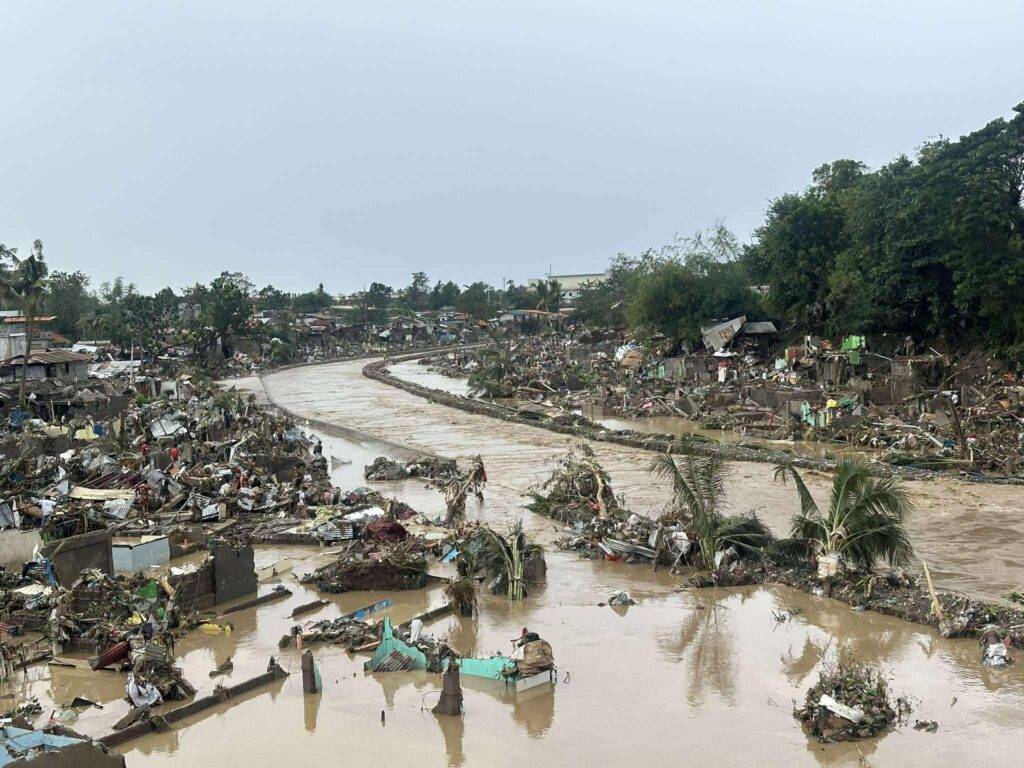
In recent weeks, parts of the central Philippines had been ravaged by a devastating earthquake followed by a powerful typhoon. The back-to-back disasters have amplified suffering for already vulnerable communities, especially in the Visayas region, leaving thousands reeling from loss, fear, and uncertainty.
The Earthquake’s Toll
On September 30, 2025, a magnitude 6.9 earthquake struck off the coast of Bogo City, Cebu. One of the strongest ever recorded in northern Cebu. By conservative estimates, the disaster killed at least 79 people and injured more than 1,200, while damaging tens of thousands of homes. The quake triggered widespread power outages, disrupted water supplies, and collapsed infrastructure — leaving entire communities unable to access basic services.
A Double Blow: Typhoon Direct Hit
Just over a month later, Typhoon Kalmaegi (locally named Tino) made landfall across the Visayas with harrowing force. According to disaster authorities, the typhoon caused at least 204 deaths, with more than a hundred people missing. The storm displaced hundreds of thousands of people, as floodwaters surged and rivers overflowed.
Life-saving services remain under strain. The International Federation of Red Cross and Red Crescent Societies (IFRC) reported that after the typhoon, more than 377,000 people were sheltering in crowded evacuation centers. Power outages affected 156 municipalities, and water supply was cut off in at least seven cities. All of which raise the risk of disease outbreaks.
The Human Impact: Children and Families on the Edge
For many families, the earthquake had only just begun to leave scars when the typhoon struck. Homes weakened or partially destroyed by the quake were pounded by rain and wind; makeshift shelters were flooded and swept away. In many cases, families who had sought refuge in fragile evacuation centers found themselves displaced again, this time by floodwaters.
The emotional toll has been deep. Loss of loved ones, damaged homes, and the threat of future storms have compounded trauma, especially for children. The coordination of relief efforts has been challenged by damaged roads, clogged waterways, and downed communication lines, making it hard for aid to reach those most in need.
How Food For Every Child Is Helping
At Food For Every Child, we have watched the unfolding crisis with deep concern. Though we were not on the ground in the Philippines during the disaster, we have mobilized support through trusted networks and partners.
We have provided financial resources to trusted contacts in the Visayas region, channeling funds to help purchase essential supplies. Specifically, our support has gone toward food, water, and other basic needs for displaced families and children.
We have focused on local relief groups and grassroots organizations, enabling rapid, culturally sensitive aid distribution. By backing local actors, we aim to support recovery efforts in a way that respects community needs and promotes dignity. While our role is not one of direct implementation, we hope that our contributions help prevent hunger and provide a measure of relief amid overwhelming challenges.
A Call to Solidarity
The crisis in the Visayas is not just a natural disaster story, it is a human story of resilience pushed to its limits. As millions face uncertain days ahead, the need for humanitarian support is urgent and sustained.
Food For Every Child is committed to doing our part. We invite our community, supporters, and partners to join us in offering life-saving aid. Every contribution helps families rebuild, children recover, and communities heal.